Four teams of woodcutters were timed cutting three types of log, with and without bark. One way of modeling these data is as Poisson counts of tenths of seconds. The better teams take less time.
Facets specifications and data (in file Woodcut.txt):
title = Woodcutting Experiment (David Wallace)
facets = 3 ; trees, bark, teams
arrange = N,3f ; "N": output tables of measures arranging all facets by element number
; "3f": also arrange facet 3, teams, by fit
positive = 1,2 ; higher time, harder to cut. Lower time, better team - facet 3
noncenter=3 ; non-center the teams
vertical=1A,2A,3N ; elements reported on vertical rulers by alphabetical name, where known
model=?B,?B,?,Chops ; time to cut through log in 10ths seconds. Bias interactions between trees and bark.
*
rating scale=Chops,P ; model as Poisson counts with estimated step difficulty
*
Labels =
1,Tree
1=Spruce ; 3 types of log
2=Pine
3=Larch
*
2,Bark
1,Without bark ; each log, with and without bark
2,With bark
*
3,Wood cutting team
1-4= ; names of 4 teams unknown
*
Data =
1,1,1,64 ; the spruce without bark was cut by team 1 in 6.4 seconds
| ; 22 more data points
3,2,4,61 ; the larch with bark was cut by team 4 in 6.1 seconds
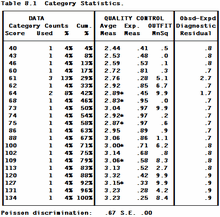
Poisson scales imply an infinite number of categories, 0,1,2,3,..., but with a known relationship. Facets reports the degree to which the data meets this categorization: