Convergence considerations

Top Up Down  A A

For early runs, set the convergence criteria loosely, or use Ctrl+F to stop the iterations.


If in doubt, set the convergence criteria very tightly for your final report, e.g.,

CONVERGE=B ; both LCONV= and RCONV= apply

LCONV= .0001 ; largest logit change .0001 logits

RCONV= .01 ; largest score residual .01 score points

MJMLE= 0 ; unlimited JMLE iterations

and be prepared to stop the iterations manually, if necessary, using "Finish Iterating", Ctrl+F, on the File pull-down menu


Remember that convergence criteria tighter than the reported standard error of a measure are somewhat of a numerical fiction.


The Rasch model is non-linear. This means that estimates cannot be obtained immediately and exactly, as can be done with the solution of simultaneous linear equations. Instead, estimates are obtained by means of a series of guesses at the correct answer.


The initial guess made by Winsteps is that all items are equally difficult and all persons equally able. The expected responses based on this guess are compared with the data. Some persons have performed better than expected, some worse. Some items are harder than expected, some easier. New guesses, i.e., estimates, are made of the person abilities and item difficulties, and also the rating (or partial credit) scale structures where relevant.


The data are again examined. This is an "iteration" through the data. Expectations are compared with observations, and revised estimates are computed.


This process continues until the change of the estimates is smaller than specified in LCONV=, or the biggest difference between the marginal "total" scores and the expected scores is smaller than specified in RCONV=. The precise stopping rule is controlled by CONVERGE=. When the estimates are good enough, the iterative process has "converged". Then iteration stops. Fit statistics are computed and the reporting process begins.


There are standard convergence criteria which are suitable for most small and medium-sized complete data sets. LCONV= is harder to satisfy for small complete data sets and many sparse data designs, RCONV= for large complete data sets.


The "least converged" persons (and items) are those that Winsteps is having the most difficulty estimating. This is not usually because their responses misfit the model but because their scores are extreme. It is more difficult to estimate the measure for a person who scores 1 out of 20 than of a person who scores 10 out of 20 (even if the 10 out of 20 greatly misfit the model). This is because Rasch estimation is done as though the data fit the model. Then, after the estimates have been made, the data are evaluated to determine the extent to which the data do fit the model. It is the same process in linear regression. The parameters are estimated as though the data fit the linear regression model. Then the data are investigated to see whether they do. It is at this later stage that outliers are detected. The Rasch model is a special case of logit-linear regression.


Anchored analyses

Anchor values always misalign somewhat with the current dataset unless they are estimated from it. Thus, the maximum residuals can never reduce to zero. Convergence occurs when the maximum logit change is too small to be meaningful. Accordingly, RCONV= is unproductive and only LCONV= is useful. Suggested specifications are:

CONVERGE = L ; only LCONV is operative

LCONV = .005  ; smaller than visible in standard, two decimal, output.


Missing data

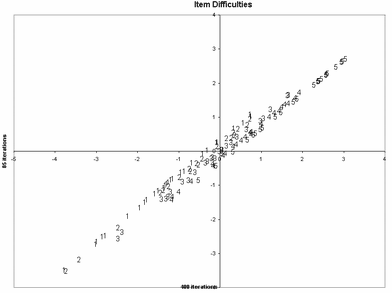
For some data designs much tighter criteria are required, particularly linked designs with large amounts of missing data. For instance, in a vertical equating design of 5 linked tests, standard convergence occurred after 85 iterations. Tightening the convergence criteria, i.e., using smaller values of LCONV= and RCONV=, convergence occurred after 400 iterations. Further iterations made no difference as the limit of mathematical precision in the computer for this data set had been reached. The plot shows a comparison of the item difficulties for the 5 linked tests estimated according to the standard and strict convergence criteria.

CONVERGE = B

LCONV = .001  ; 10 time stricter than usual

RCONV = .01  ; 10 times stricter than usual

Note that convergence may take many iterations, and may require manual intervention to occur: Ctrl+F.


Help for Winsteps Rasch Measurement Software: www.winsteps.com.

Facets Rasch measurement software $149.
Winsteps Rasch measurement software $149.

State-of-the-art : single-user and site licenses : free student/evaluation versions : download immediately : instructional PDFs : user forum : assistance by email : bugs fixed fast : free update eligibility : backwards compatible : money back if not satisfied
 
Rasch, Winsteps, Facets online Tutorials

ForumRasch Measurement Forum to discuss any Rasch-related topic

To receive the monthly News Email about Winsteps and Facets,
enter your email address here:

I want to Subscribe: & click below
I want to Unsubscribe: & click below

Please set your SPAM filter to accept emails from Winsteps.com
www.winsteps.com welcomes your comments:

Your email address (if you want us to reply):


Rasch Publications
Rasch Measurement Transactions (free, online) Rasch Measurement research papers (free, online) Probabilistic Models for Some Intelligence and Attainment Tests, Georg Rasch
Applying the Rasch Model 2nd. Ed., Bond & Fox (Winsteps) Best Test Design, Wright & Stone Rating Scale Analysis, Wright & Masters
Introduction to Rasch Measurement, E. Smith & R. Smith Introduction to Many-Facet Rasch Measurement, Thomas Eckes (Facets) Invariant Measurement: Using Rasch Models in the Social, Behavioral, and Health Sciences, George Engelhard, Jr. (Facets)
Statistical Analyses for Language Testers, Rita Green (Winsteps, Facets) Rasch Models: Foundations, Recent Developments, and Applications, Fischer & Molenaar Journal of Applied Measurement
Winsteps Tutorials Facets Tutorials Rasch Discussion Groups

Coming Rasch-related Events
Apr. 25-26, 2013, Thurs.-Fri. In-person workshop: Introduction to Rasch Measurement (R. Smith, N. Bezruczko), San Francisco CA, www.jampress.org
April 27 - May 1, 2013, Sat.-Wed. AERA Annual Meeting, San Francisco, CA, www.aera.net
May 3, 2013, Fri. ORVOMS: Ohio River Valley Objective Measurement Seminar, Lexington, Kentucky, Announcement
May 15-17, 2013, Wed.-Fri. In-person workshop: Introductory Rasch (A. Tennant, RUMM), Leeds, UK, www.leeds.ac.uk/medicine/rehabmed/psychometric
May 20-22, 2013, Mon.-Wed. In-person workshop: Intermediate Rasch (A. Tennant, RUMM), Leeds, UK, www.leeds.ac.uk/medicine/rehabmed/psychometric
May 31 - June 28, 2013, Fri.-Fri. On-line workshop: Practical Rasch Measurement - Core Topics (E. Smith, Winsteps), www.statistics.com
June 7, 2013, Fri. SPHERE workshop: Response-Shift and subjective measures in health science, Nantes, France, www.sphere-nantes.fr/
June 19-21, 2013, Wed.-Fri. SIS 2013 Conference on Advances in Latent Variables: Methods, Models and Applications, Brescia, Italy, meetings.sis-statistica.org/index.php/sis2013/ALV
July 1 - Nov. 30, 2013, Mon.-Sun. Online Course: Introduction to Rasch Measurement Theory (D. Andrich, RUMM), uwa.edu.au
July 5 - Aug. 2, 2013, Fri.-Fri. On-line workshop: Practical Rasch Measurement - Further Topics (E. Smith, Winsteps), www.statistics.com
Aug.1-5, 2013, Thur.-Mon. TERA-PROMS Annual Meeting, Kaohsiung, Taiwan, tera.education.nsysu.edu.tw
Aug. 9 - Sept. 6, 2013, Fri.-Fri. On-line workshop: Many-Facet Rasch Measurement (E. Smith, Facets), www.statistics.com
Aug. 22, 2013, Thursday. Symposium in honor of Svend Kreiner, Copenhagen, Denmark, biostat.ku.dk/kreinersymposium
Sept. 4-6, 2013, Wed.-Fri. IMEKO TC1-TC7-TC13 Symposium: Measurement Across Physical and Behavioural Sciences, Genoa, Italy, www.imeko-genoa-2013.it
Sept. 13 - Oct. 11, 2013, Fri.-Fri. On-line workshop: Rasch Applications in Clinical Assessment, Survey Research, and Educational Measurement (W.P. Fisher), www.statistics.com
Sept. 18-20, 2013, Wed.-Fri. In-person workshop: Introductory Rasch (A. Tennant, RUMM), Leeds, UK, www.leeds.ac.uk/medicine/rehabmed/psychometric
Sept. 23-25, 2013, Mon.-Wed. In-person workshop: Intermediate Rasch (A. Tennant, RUMM), Leeds, UK, www.leeds.ac.uk/medicine/rehabmed/psychometric
Sept. 26-27, 2013, Thurs.-Fri. In-person workshop: Advanced Rasch (A. Tennant, RUMM), Leeds, UK, www.leeds.ac.uk/medicine/rehabmed/psychometric
Oct. 18 - Nov. 15, 2013, Fri.-Fri. On-line workshop: Practical Rasch Measurement - Core Topics (E. Smith, Winsteps), www.statistics.com
Oct. 20 - Oct. 25, 2013, Sun.-Fri. International Association for Educational Assessment (IAEA) 39th Annual Conference, Tel Aviv, Israel, www.iaea-2013.com
Dec. 11-13, 2013, Wed.-Fri. In-person workshop: Introductory Rasch (A. Tennant, RUMM), Leeds, UK, www.leeds.ac.uk/medicine/rehabmed/psychometric
March 12-14, 2014, Wed.-Fri. In-person workshop: Introductory Rasch (A. Tennant, RUMM), Leeds, UK, www.leeds.ac.uk/medicine/rehabmed/psychometric
May 14-16, 2014, Wed.-Fri. In-person workshop: Introductory Rasch (A. Tennant, RUMM), Leeds, UK, www.leeds.ac.uk/medicine/rehabmed/psychometric
May 19-21, 2013, Mon.-Wed. In-person workshop: Intermediate Rasch (A. Tennant, RUMM), Leeds, UK, www.leeds.ac.uk/medicine/rehabmed/psychometric
July 4 - Aug. 1, 2014, Fri.-Fri. On-line workshop: Practical Rasch Measurement - Further Topics (E. Smith, Winsteps), www.statistics.com
Aug. 8 - Sept. 5, 2014, Fri.-Fri. On-line workshop: Many-Facet Rasch Measurement (E. Smith, Facets), www.statistics.com
Sept. 10-12, 2014, Wed.-Fri. In-person workshop: Introductory Rasch (A. Tennant, RUMM), Leeds, UK, www.leeds.ac.uk/medicine/rehabmed/psychometric
Sept. 12 - Oct. 10, 2014, Fri.-Fri. On-line workshop: Rasch Applications in Clinical Assessment, Survey Research, and Educational Measurement (W.P. Fisher), www.statistics.com
Sept. 15-17, 2014, Mon.-Wed. In-person workshop: Intermediate Rasch (A. Tennant, RUMM), Leeds, UK, www.leeds.ac.uk/medicine/rehabmed/psychometric
Sept. 18-19, 2014, Thurs.-Fri. In-person workshop: Advanced Rasch (A. Tennant, RUMM), Leeds, UK, www.leeds.ac.uk/medicine/rehabmed/psychometric
The javascript to add "Coming Rasch-related Events" to your webpage is:
<script type="text/javascript" src="http://www.rasch.org/events.txt"></script>