In a standard two-facet Knox Cube analysis, respondent gender (sex) is indicated, but item bias (DIF, differential item functioning) is not computed. Here we add a DIF detection by coding a dummy "gender" Facet.
The Knox Cube Test measures short term memory (BTD p.28). There are two facets, Children and Tapping Items. Observations are scored as dichotomies, 1 for correct and 0 for incorrect.
Facets specifications and data (in file Kcta.txt):
Title = Knox Cube Test (Best Test Design p.31) ; the report heading line
Facets = 3 ; three facets: children and items and gender
Positive = 1 ; for facet 1, children, higher score = higher measure
Noncenter = 1 ; only facet 1, children, does not have mean measure set to zero
Pt-biserial = Yes ; report the point-biserial correlation
Vertical = 1*,1A,2N,2A ; show children by distribution and sex, taps by number and name
Yard = 112,4 ; Vertical rulers 112 columns wide, with 4 lines per logit
Model = ?,?B,?B,D ; look for bias/interaction between 2nd and 3rd Facets
Label
1,Children ; Children are facet 1
1-17 = Boy,,1 ; Pretend boys, in group 1, are numbered 1 through 17.
18-35 = Girl,,2 ; Pretend girls, in group 2, are numbered 18 through 35.
* ; end of child labels for facet 1
2,Tapping items ; Items are facet 2
1 = 1-4 ; Items labelled by the order in which the four blocks are tapped
2 = 2-3
3 = 1-2-4
4 = 1-3-4
5 = 2-1-4
6 = 3-4-1
7 = 1-4-3-2
8 = 1-4-2-3
9 = 1-3-2-4
10= 2-4-3-1
11= 1-3-1-2-4
12= 1-3-2-4-3
13= 1-4-3-2-4
14= 1-4-2-3-4-1
15= 1-3-2-4-1-3
16= 1-4-2-3-1-4
17= 1-4-3-1-2-4
18= 4-1-3-4-2-1-4
*
3,Gender,A ; Dummy gender facet is anchored
1=boys,0 ; anchor at 0 so do not affect analysis
2=girls,0 ; anchor at 0 so do not affect analysis
* ; end of item labels
Data = ; no data file name, so data follows immediately in this file
1,1,1, 1 ; child 1 on item 1 is a boy scored 1 (blanks are ignored)
1,2-18,1, 1,1,1,1,1,1,0,0,0,0,0,0,0,0,0,0,0 ; child 1 on item 2 is a boy scored 1, on item 3 scored 1, etc to item 18
| ; 594 more observations, 18 per data line
35,1-18,2, 1,1,1,0,0,0,0,0,0,0,0,0,0,0,0,0,0,0 ; child 35, a girl, scored 1 on items 1-3, 0 on items 4-18
Here is the DIF report:
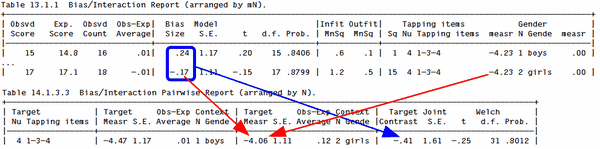
The reported DIF is against the overall item difficulty. The boys vs. girls DIF size on item 4, tapping pattern 1-3-4, is:
DIF size = Target Contrast Target measure for boys - Target measure for girls = -.4.47 - -4.08 = -.41.
We can see by comparing the observed and expected scores, that the boys scored 15 when 14.8 was expected, and the girls 17 when 17.1 was expected. So the item was .41 logits easier for the boys than for the girls. The t-test for this DIF size is approximately DIF size / joint standard error: t = -.41 / sqrt(SE(boy)² + SE(girl)²) = -.41/ sqrt(1.17²+1.11²) = .43/1.61 = -.25 with (boys count - 1 + girls count - 1) = 32 degrees of freedom. P=.80 for a 2-sided t-test. So this is not statistically significant. The hypothesis of "No DIF" is not rejected.
