For judged ratings, paired comparisons and complex ordinal data structures...
Facets
Many-Facets Rasch Measurement - MFRM - software for Rasch Analysis
64-bit version: Facets 4.4.0, July 2025, Windows 8.1, 10, 11 compatible.
32-bit version: Facets 3.87.0, November 2023, Windows XP to Windows 11 compatible.
Buy Winsteps or Facets now.
Mac, Linux,Chrome OS: Winsteps and Facets run under Windows installed on the target hardware using special-purpose software.
Facets is 64-bit or 32-bit Windows software. Please check compatibility by downloading and running the free student/evaluation/demo version, Minifac
- same as Facets but limited to 2,000 data points.
Free, Windows-native, evaluation/student version of FACETS,
called MINIFAC.
Contains all features except limited to 2,000 data points (responses).
Please copy, distribute and use.
Capacity of full version of Facets: over 1,600,000 elements (persons + items + raters + tasks + ....), up to 2 billion observations, tested to 250 million
Winsteps vs. Facets comparison
Customer support policy and user comments.
Facets users and site license holders
List of citations to Facets in scholarly Papers
|
Click here for bigger picture.
|
Facform, free data-formatter for Facets
Our recommendation: use EXCEL etc. instead
- Freeware Facform data formatter

Facets & Facform User Manuals and On-Line Help
Get started with Facets Tutorial PDFs
Go to Facets 64-bit Online Help
Go to Facets 32-bit Online Help
Go to Facform Online Help for Facets data formatter
- Facets 32-bit User Manual PDF .
- Facets 64-bit User Manual PDF .
- Facform User Manual PDF .
Facets

Staff of Suzann Campbell's baby-measuring project. Mike Linacre is top center.
See RMT 10:2. |
|
| Useful for all Facets users:
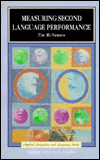
"Measuring Second Language Performance" by T. F. McNamara, Addison-Wesley Longman, 1996.
Available from Amazon.com
|
| Introduction to Many-Facet Rasch Measurement by Thomas Eckes (2011), Frankfurt am Main: Peter Lang. |
|
The book "Many-Facet Rasch Measurement" by John M. Linacre, Chicago: MESA Press, 1992, is available from
https://www.rasch.org/books.htm
|
Go to Example of Facets Output
Facets is designed to handle applications of
unidimensional many-facets Rasch measurement from the simple to the really tough. It constructs measures from
complex data involving combinations of different facets, such as examinees,
items, tasks, judges along with further measurement and structural
facets. It is designed to handle combinations of items of
different formats in one analysis. Item types include dichotomies,
rating scales with up to 255 categories, Poisson counts and
Bernoulli trials. Multiple different measurement models can be
included in the same analysis, including paired-comparisons, rank-order,
Likert and other rating scales, partial credit, and dichotomizations, all involving
from 1 to 255 facets. For instance, two-facet person-item multiple-choice questions can be included in the same analysis as
four-facet person-rater-task-item ratings. Measures can also be fixed (anchored)
individually or by group mean, facilitating equating and linking
across test sessions. Quality-control fit evaluation of all
measures is provided. Unexpected data points are identified.
Bias, differential item functioning and interactions can be
measured. Weighting schemes can be implemented. Up to 4 million individual elements, such as
examinees, raters, etc., can be included in one analysis. Typical
applications have over 90% missing data. Multiple observations are allowed in each cell of the data matrix.
Facets has been used successfully to construct measures for language testing,
medical staff performance, patient performance, public speaking,
sports performance by individuals and teams, and consumer
preferences. Training courses are held regularly.
Student/evaluation/demo versions of Facets, called Minifac, can be downloaded free
from www.winsteps.com/minifac.htm.
Go to recent enhancements, changes and bug fixes to Facets.
Description of FACETS program
This program extends the objective measurement principles of Georg Rasch beyond conventional tests and attitude surveys into more
complex areas such as judged performances, and sub-tests of items replicated across tasks. Facets has already been applied in many
areas including Drama Competition, Laboratory Technician Certification, Handicapped Patient Assessment, Stain Resistance of Paints,
Public Speaking Competence, Graduate-School Candidate Selection, Teacher Assessment and Essay Grading.
Judged tests can be analyzed: Facets can analyze the ratings awarded by judges to examinees who are being tested on their performance
on a number of different skill items for each of several tasks. The choice of judging design is yours: from complete designs in which
every judge rates every examinee, to minimal designs in which any judge only rates a few of the examinees on a few of the items. The
only constraint is that there be enough overlap or rotation in the judging design to enable each parameter to be uniquely positioned
within one overall frame of reference.
Heterogeneous tests can be analyzed together: Not only can Facets perform analyses as diverse as dichotomous responses and judge-
awarded ratings, but Facets can process them together simultaneously in one analysis to estimate one ability measure for each examinee.
Mathematical flexibility: The analyst specifies to Facets the number of facets in the data, and, for each facet, its name and the names
of all the parameters included in the facet. The analyst also specifies the form of the measurement model which represents the way
in which the facets interacted to produce the observations, and which observations apply to a given model, so that multiple measurement
models can be used simultaneously in one analysis. For a complex judged test, the measurement model could be equivalent to:
where Bn = ability of examinee n, Am = difficulty of task m,
Di = difficulty of skill item i, Cj = severity of judge J,
Fk = difficulty of category k relative to category k-1,
Pnmijk = probability of rating of k under these circumstances,
Pnmijk-1 = probability of rating of k-1
Input data: Facets can process up to 255 facets, containing millions of elements in total, and millions of individual observations.
The structure of the data file, though simple, usually requires the analyst to reformat the raw data file before analysis. A utility
program Facform is provided, which will usually accomplish this for small data files.
Elements can be grouped within facets so that summary statistics can be produced by group.
Measures can be pre-set by element or by group to facilitate equating. Rating scale calibrations can also be pre-set. Results of
earlier analyses can also be used as starting values for later analyses.
Secondary analysis can be performed to identify interaction (bias) between pairs of elements. Location, size and significance of
interactions are reported, e.g., interaction (bias) between individual judges and individual items.
Rating scales can be defined as applying to all elements, or scales can be specified to be particular to each item, or each judge or
any element of any facet, up to 255 distinct scales, with up to 255 categories per scale..
Individual misfitting observations are reported. No need to edit the data file in order to eliminate misfitting observations from
further analysis.
Weighting of observations allows examination board to determine the contribution of each sub-test to the estimate of person measure.
Data formats include: dichotomous, rating scales, partial credit, Bernoulli trial (e.g. number of hits on target) and Poisson count
(e.g. number of spelling mistakes in a long essay).
Facets runs under Windows 11, 10, 8.1. Windows version analyzes millions of people, item, judges.
Facets is not 508 VPAT compliant - see VPAT document. The earlier
MS-DOS version of Facets, called FacDOS
is text-only and so is 508 VPAT compliant. FacDOS is now freeware.